
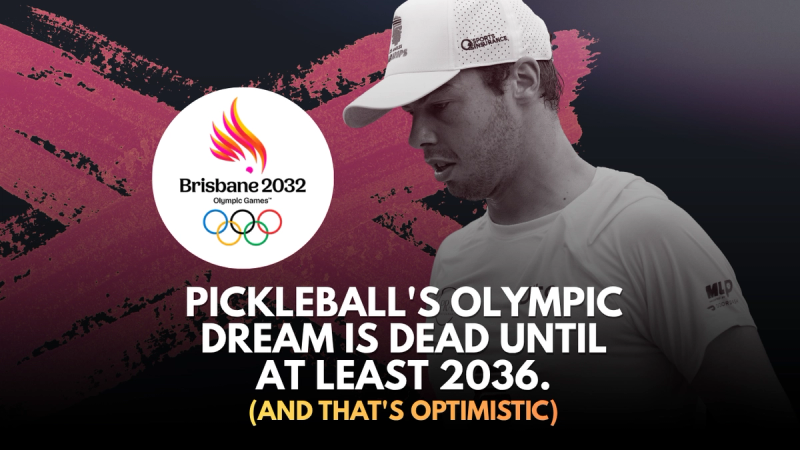
Pickleball's Olympic Dream Is Dead Until at Least 2036. And That's Optimistic.
Pickleball has booming pro tours and $225 million in investment, but no international federation recognized by the IOC. That leaves it off LA 2028, likely out of Brisbane 2032, and facing long odds even for 2036.
Jump to a section4 sections
Breakdancing had its viral Olympic moment in Paris. It was left off the LA 2028 program, but it's still in the running for Brisbane 2032.
Pickleball isn't even that far along.
While Raygun spun across the floor in Paris, Ben Johns, Anna Leigh Waters and the pro tours were booming. Pickleball Inc. has since raised $225 million, but none of that really matters for the Olympics.
Pickleball has no international federation recognized by the International Olympic Committee (IOC), and without one, a sport can't be considered. The sport's biggest power centers, USA Pickleball and the pro tours under UPA-A, are American, and the tours are businesses. Neither can speak for pickleball worldwide.
A Major Conflict of Interest in Brisbane
An ABC News investigation found that Andrew Liveris, who leads the Brisbane 2032 organizing committee, has a financial stake in pro pickleball. Liveris is the former head of a US chemical giant and faced a corporate expenses scandal over Super Bowl tickets.
According to the ABC, Liveris holds an interest in nearly 70% of the holding company behind PPA Tour Australia. His son, Anthony Liveris, is its president. PPA Tour Australia partners with Pickleball Inc., the US parent company of the PPA Tour, which has openly talked about Olympic ambitions.
Liveris disclosed a possible conflict in 2024, listing a stake in a pro pickleball team on the committee's register. He declined to comment to the ABC about pickleball. However, committee documents clearly describe rules for managing conflicts, such as limiting what information a conflicted member can see.
Brisbane 2032 should explain exactly how this conflict was handled, and Liveris should answer questions about it. But there's no evidence he affected pickleball's chances. He couldn't have. Under the IOC's rules, pickleball was never eligible.
Who Runs Pickleball?
The IOC judges a sport by its international federation. That body must show global reach, sound leadership, stable finances, real international competition, a voice for athletes and programs that protect athletes from abuse. It must also follow the World Anti-Doping Code.
Pickleball doesn't have that. What it does have is a pile of rival federations.
The World Pickleball Federation (WPF) merged with the International Pickleball Federation in 2025 and says it is pursuing IOC recognition. It doesn't have it.
The Global Pickleball Federation and the United World Pickleball Federation announced their own merger talks that same year. The sport is huge, and it still hasn't settled who speaks for it.
The WPF's own checklist shows how far it has to go. Its constitution is still a draft. Its anti-doping program is still being built. Its global membership is still a work in progress. A sport can't call itself Olympic-ready while its foundation is a rough work in progress.
Compare that with padel, which is already ahead in the Olympic race partly because it had one international federation to begin with. Pickleball needs to stop treating this as a side issue.
Money Can't Buy an Olympic Spot
It's easy to see why fans look at the money and the growth and assume the Olympics should want pickleball. Pickleball Inc. raised $225 million. Prize money is big. Supporters claim 22 million people play worldwide, though that number is hard to verify.
None of that answers the IOC's questions. Who governs the sport? Who represents national federations? Who sets the rules for international play? Who runs drug testing? Who protects athletes? Who is accountable when something goes wrong?
The PPA Tour and Major League Pickleball (MLP) have done a lot for the sport. They brought in sponsors, raised its profile and gave players legitimate careers. But they are businesses, and a business can't be a sport's international governing body. It shouldn't try to be.
The two can work together. The tours can bring money, attention and top-level competition. An independent federation should handle the rules, the national associations and global oversight. Those roles need clear lines between them.
Liveris shows what happens when business interests and Olympic hopes get tangled. If pickleball wants the IOC to take it seriously, it has to prove its leadership serves the sport, not just the companies making money from it.
The Door Is Closing
Even if pickleball fixed its leadership problem tomorrow, it would face long odds. LA 2028 added five sports in October 2023: baseball/softball, cricket, flag football, lacrosse and squash. Pickleball wasn't one of them.
Brisbane will be smaller.
Under IOC President Kirsty Coventry's "Fit for the Future" review, the 10,500-athlete cap stays in place, and Coventry has said Brisbane will have fewer sports than LA's 36. Cost is a big reason.
As she told the Associated Press in May, adding sports can mean building new venues. The IOC is also considering a limit of four added sports per Summer Games.
So fixing its governance only gets pickleball to the starting line. It would still have to beat other sports for very few spots. The next real chance is 2036, and that host city won't be picked until 2029. Before pickleball can make its case to the IOC, it has to ultimately answer a simpler question: who's in charge?