Pickleball's Patent War: Will Joola's Sweeping IP Claim Kill Paddle Innovation?
Pickleball's Patent War: How Joola's Sweeping IP Claim Could Reshape the Sport A federal trade complaint against eleven brands, a fraud scandal heading into discovery, and a question the entire industry is now asking: who can still build a competitive paddle?
Jump to a section9 sections
Pickleball has spent the last five years growing faster than any sport in America. Its equipment has kept pace — each generation of paddles meaningfully better than the last. That era of open innovation may be ending.
On April 7, 2026, Sport Squad, Inc. — which operates under the Joola brand — filed a complaint with the U.S. International Trade Commission asserting two patents that together cover a significant portion of the most advanced paddle construction techniques in the sport. The complaint names eleven brands as infringers. A successful outcome for Joola could result in exclusion orders barring imported paddles from entering the U.S. market — a potentially fatal outcome for brands that manufacture in China.
The filing doesn't just affect the companies named. It sends a message to every paddle manufacturer trying to figure out what they're allowed to build next.
Speak Pickleball is an independent publication covering the pickleball industry. We are not lawyers, and nothing in this article constitutes legal advice. The analysis of patent claims, court filings, and legal proceedings reflects our own reading of publicly available documents and should not be relied upon as a definitive legal interpretation. The facts of these cases are active and evolving — rulings, settlements, and filings may have occurred after publication. Readers with a direct stake in any of the proceedings discussed should consult qualified legal counsel.
Who Did Joola Target?
Joola's press release identified eleven brands as targets. The ITC complaint, which names the underlying legal entities rather than consumer-facing brands, lists twelve respondents: Franklin Sports, Proton Sports, Vegas Pickleball LLC (d/b/a RPM Pickleball), Engage Pickleball, Friday Labs, Diadem Sports, Facolospickleball, Paddletek, ProXR, All Racquet Sports LLC, All For Padel S.L., and Volair.
The discrepancy comes down to Adidas. All Racquet Sports LLC develops and manufactures Adidas pickleball paddles, and All For Padel S.L. is the Spanish entity associated with the Adidas line. Joola's PR named the brand; the legal filing named the companies behind it. Either way, Adidas — one of the largest sports equipment companies in the world — is on the list.
What the Patents Actually Cover and What They Don't
To understand the scope of what Joola is asserting, you have to understand the difference between what a patent describes and what it actually protects.
A patent's specification can be sweeping — describing materials, variations, and possibilities in broad terms. But what's legally enforceable lives entirely in the granted claims.
The analysis below reflects our reading of the publicly available claim language and court filings. We are not lawyers, and nothing here constitutes legal advice. Those with a direct stake in these proceedings should consult qualified IP counsel.
Joola holds two granted patents, both filed by inventor Fabio Kachiwazaki and both issued in late 2025:
U.S. Patent No. 12,357,891 — the narrower of the two — protects the throat foam block architecture that Joola markets as TechFlex Power. Claim 1 covers two gaps carved into the core material adjacent to the throat, one on each side, filled with foam, with a frame that sits physically within those gaps and forms a boundary along the paddle's interior. This is the construction that prevents the traditional neck-flex of a honeycomb core — rather than the face flexing from the throat, the foam inserts absorb and redirect that energy. To infringe Claim 1, a paddle must have all three elements together: the two throat-adjacent gaps, the filler inside them, and the frame anchored within them.
U.S. Patent No. 12,465,826 — the broader and more commercially significant of the two — protects a different architecture. Claim 1 requires five elements, all present simultaneously: (1) a core whose outer boundary partially terminates inside the paddle perimeter, and partially terminates closer to the perimeter; (2) a gap external to the core, between the core's edge and the paddle's internal perimeter; (3) a first filler material within that gap; (4) a hollow frame running along the edge of the paddle's head; and (5) a second filler material inside that hollow frame.
What makes this claim particularly broad is the repeated use of "at least" throughout the language. The gap only needs to extend around "at least" part of the core boundary. The filler only needs to fill "at least a portion" of that gap. The frame only needs to run along "at least a head portion" of the paddle. Each element is written with significant flexibility built in — meaning a partial floating core, a partially filled gap, or a frame that only covers part of the head still qualifies. A manufacturer cannot escape the claim simply by making these features partial rather than complete. That makes designing around it considerably harder than a narrow reading would suggest, and likely explains why so many brands find themselves on the list. Why certain floating core brands are absent likely comes down to something more specific in the geometry of how their core terminates relative to the frame, or to the prior art landscape, rather than any single structural distinction.
Both patents are material-agnostic. The core can be polypropylene, foam, and everything in between. The filler can be EVA, TPU, MPP, EPP. What is protected is the structural relationship between components — not the specific materials used to achieve it.
The patents were examined with at least some prior art on the table. The '826 patent's reference list includes a Wayback Machine capture of the Selkirk LABS Project 002 product page, dated June 2022, and a citation for Gearbox's Pro Power Elongated paddle. The examiner reviewed those references and granted the patents regardless.
RPM is the Only Brand Named Twice
RPM Pickleball is the sole respondent accused under both patents. The complaint includes separate, extensive claim charts mapping RPM's Friction Pro paddle against each patent independently. Among all the brands named, RPM seems to be in the most precarious legal position.
The ITC's Section 337 mechanism is specifically designed for disputes involving imported goods. The complaint notes that RPM, Engage, Friday, and Volair manufacture in China — making the threat of an exclusion order particularly acute for those brands.
The Paddletek Timeline and What It Means for Franklin
Of all the stories embedded in this complaint, perhaps none is more instructive than Paddletek's.
Paddletek is one of pickleball's founding equipment brands, in the game since 2010. For years, its paddles were built around traditional honeycomb polymer cores that were cold pressed rather than thermoformed. That technology did not fall under Joola's patents. Paddletek, under its original design direction, would not have been on this list.
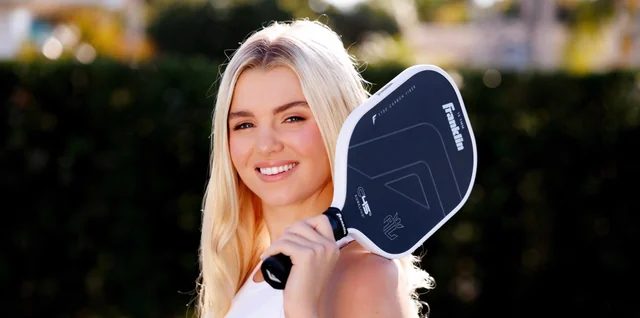
Then, on December 31, 2025, Anna Leigh Waters — the world's No. 1 ranked player across all three disciplines, and Paddletek's signature athlete for seven years — let her contract expire. Eight days later, she signed with Franklin Sports in what is widely reported as the sport's first $10 million sponsorship deal.
Nineteen days after that, on January 27, 2026, Paddletek launched the Reserve Honeyfoam — described in its own press release as the company's first foam-based product. The paddle is built around what Paddletek calls a three-foam floating core architecture: an EPP foam core wrapped in EVA foam from the 4 to 8 o'clock positions, completed by a perimeter foam ring. The design was explicitly marketed as a step-change from everything Paddletek had built before. In independent reviews, the construction was described in terms that closely mirror the architecture covered by Joola's '826 patent. Ten weeks later, Joola filed the ITC complaint naming Paddletek as a respondent.
A brand loses its star athlete, pivots to foam construction to stay competitive in a market that has moved on, and ends up in a federal patent proceeding before the product has been on sale for three months. Adding another wrinkle: in late 2025, Paddletek had merged with ProXR, Padeltek, and Yobow to form Paddletek Group — and ProXR is named separately in the ITC complaint under its pre-merger legal identity. Two members of the same newly consolidated company are on the respondent list.
Waters, meanwhile, landed at Franklin Sports — which is also on the list. She left one Joola target and arrived at another.
For Franklin, the stakes are uniquely high: the company is mid-way through releasing her signature Aurelius paddle line, built around the same advanced core architecture that sits at the center of Joola's complaint.
Franklin and Adidas are the two respondents with the resources and legal infrastructure to mount a sustained defense. For Adidas, the calculus may come down to whether fighting the case aligns with their strategic ambitions in the pickleball market, or whether a licensing arrangement is the cleaner path. For Franklin, there is no clean path.
Kicking Proton While It's Down
If the Paddletek situation is instructive, the Proton Sports situation is something else.
On March 27, 2026 — eleven days before Joola filed its complaint — PPA Tour founder and CEO Connor Pardoe sent a memo to professional players announcing that Proton paddles were banned from sanctioned professional play, effective at the conclusion of the Greater Zion Cup on March 30. The reason, per the memo: Proton "has failed to resolve its outstanding debts and is now in bad standing with the United Pickleball Association, the PPA Tour, Major League Pickleball, and Pickleball Inc."
The memo went further, informing pros that Proton-sponsored athletes may also be owed "significant sums" by the company, and encouraging them to pursue those debts directly. Proton had previously been a title sponsor of the PPA Tour. Its association with the MLP's Phoenix Flames franchise had already ended.
Into that situation — a brand banned from pro play, apparently unable to meet its financial obligations to the governing body and its own athletes — Joola filed a federal trade complaint eleven days later, one that requires Proton to mount a defense in an ITC investigation that typically costs millions of dollars to litigate.
Whatever the merits of the patent claims against Proton's paddles, the timing is strikingly unfortunate.
How Will Brands Innovate?
The ITC complaint does not exist in isolation. Joola's patents are not the only intellectual property claims now constraining what a paddle manufacturer can build. Onix has asserted patents covering thermoforming.
CRBN has its own patent portfolio — and on April 6, 2026, the day before Joola filed its ITC complaint, CRBN and Vatic Pro filed a stipulation of dismissal in the U.S. District Court for the Central District of California, closing a patent infringement case between the two brands.
The dismissal came with no costs or fees awarded to either party — a strong indicator that a confidential settlement agreement was reached privately, the terms of which will never be made public. Notably, Vatic's counterclaims were dismissed without prejudice, meaning Vatic preserved its right to challenge CRBN's patents if litigation resumes. Joola's two newly granted patents now sit on top of that existing landscape — and the CRBN-Vatic settlement is a concrete reminder of what that landscape looks like: expensive and increasingly opaque.
For any manufacturer trying to engineer a competitive paddle in 2026, this creates a real design challenge.
Navigating around granted claims while still delivering competitive performance is solvable, but it's an expensive and uncertain one. It requires IP counsel alongside engineering talent before a prototype is built, which raises the barrier to entry and disproportionately burdens smaller brands.
The optimistic reading is that these constraints force creativity; brands with genuine R&D capacity will find new constructions that achieve similar performance through different structural means, and the sport will be better for it.
The pessimistic reading is that the most effective design directions are now legally encumbered enough that meaningful differentiation becomes harder, and the brands with the resources to license, litigate, or design around will consolidate their advantage while smaller players are simply squeezed out.
The Right to Protect What You Built
The Pro V launched in March 2026 in a market that had largely moved on.
Nearly every major competitor had pivoted to full-foam cores. Joola raised the price of their Pro series from $280 to $300 and went the other direction: deliberate iteration on polypropylene honeycomb. The core is largely unchanged from the Pro IV — same honeycomb, same Hyperfoam edge wall — with the addition of carbon-fiber reinforcement, and the KineticFrame, a redesigned throat that flexes on impact to store and release energy.
Our Apple analogy from our Instagram post still holds. Apple didn't immediately copy every feature Android manufacturers introduced — they waited until a technology was mature enough to implement without disrupting the experience their existing customers already loved. And when they believed competitors had crossed a line, they litigated aggressively.
In 2011, Apple sued Samsung for "slavishly" copying the iPhone across seven patents. By 2012, the two companies were fighting more than fifty lawsuits worldwide. A jury awarded Apple over $1 billion that year, though the figure was relitigated for years before a confidential settlement in 2018. No Samsung product was ultimately pulled from the market — but the litigation established that copying Apple's architecture came with consequences, and that any competitor wanting to build in that space had to license or engineer around it.
Joola is making the same calculation now, at a fraction of the scale. The companies on the ITC complaint list did not develop the Propulsion Core architecture. They saw it work, they saw it sell, and they built versions of it. The patent system exists precisely to give companies that invest in original engineering a window of protection before their innovations become the industry standard. As we wrote at the time of the Pro V's release: it is not a sign that pickleball technology has matured, but that Joola has matured as a brand. And a mature brand protects what it built.
Don't Forget, Joola is Fighting on Three Fronts
While the ITC complaint has the bigger structural implications for the industry, two separate federal cases may prove equally consequential for Joola itself.
The first is already resolved — at a cost. In 2025, Joola settled a consumer class action, Matus v. Sport Squad, over allegations that it falsely advertised its Gen 3 paddles as USAP-approved when they weren't. The settlement covered more than 17,000 Gen 3 paddle holders, offering a $300 refund with proof of purchase or a $150 gift code without. Attorney's fees were capped at $790,000. Joola did not admit wrongdoing. Final approval came in January 2026 — just weeks before the ITC complaint was filed.
The second is still very much alive. In 2024, Joola initiated suit against USA Pickleball Association in the U.S. District Court for the District of Maryland, arising from a dispute over USAP's certification program — the process by which manufacturers submit paddle prototypes for testing and, if approved, earn the right to display the "USAP Pickleball Approved" seal. That seal is what makes a paddle eligible for sanctioned competitive play.
USAP's counterclaim alleges that Joola submitted one paddle design for testing, received approval, and then manufactured and sold a meaningfully different, more powerful version to consumers — while continuing to display the USAP seal on the non-compliant product. A "bait-and-switch," in USAP's framing, that "created a substantial scandal within the pickleball community" and caused damage to USAP's reputation and revenue. Joola's position was that the discrepancy was accidental.
On February 20, 2026, U.S. District Judge Paula Xinis denied Joola's motion to dismiss the counterclaim on all three counts: fraudulent misrepresentation, false endorsement under the Lanham Act, and a declaratory judgment count that, if granted, would trigger a one-year probationary period barring Joola from submitting any products for USAP testing.
The case now moves into discovery.
Internal documents, design records, and communications about the paddle at the center of the allegation will be subject to production. This includes Joola's allegedly questionable communications with the UPA-A. The question of whether the switch was accidental or deliberate — and what Joola's internal record actually shows — has not yet been answered in court.
The paddles in the USAP dispute are almost certainly related to the same generation of technology now at the center of the ITC complaint. What discovery surfaces, and what it reveals about the relationship between Joola's engineering decisions and its commercial ones, remains to be seen.
Where Does Pickleball Go From Here?
For the brands on the respondent list, the options are to settle, fight, or find the prior art that makes the patents crack. Franklin and Adidas have the resources to do the latter. Proton has little to no chance to afford the former. Paddletek finds itself in a complaint it might have avoided entirely had it not scrambled to replace a star athlete with a rushed product.
The walled gardens of pickleball IP are being built higher than ever before — and for the brands trying to innovate inside them, the space left to build in just got a lot smaller.
We can't help but feel the great consolidation is coming. Only a few brands will survive it.
This article is based on publicly available court filings including the April 7, 2026 ITC Section 337 complaint filed by Sport Squad, Inc. d/b/a Joola (Investigation No. 337-TA-3898); the February 20, 2026 memorandum order issued by Judge Paula Xinis in Sport Squad, Inc. v. USA Pickleball Association, No. 8:24-cv-01712-PX (D. Md.); the April 6, 2026 stipulation of dismissal in CRBN Pickleball, LLC v. Vatic Pro, LLC, No. 8:25-cv-02790-MRA-ADS (C.D. Cal.); Joola's April 7, 2026 press release; publicly reported information regarding industry sponsorship agreements and product launches; and reporting by The Dink Pickleball and The Kitchen. No parties to the litigation responded to requests for comment prior to publication.