
.svg)


.svg)
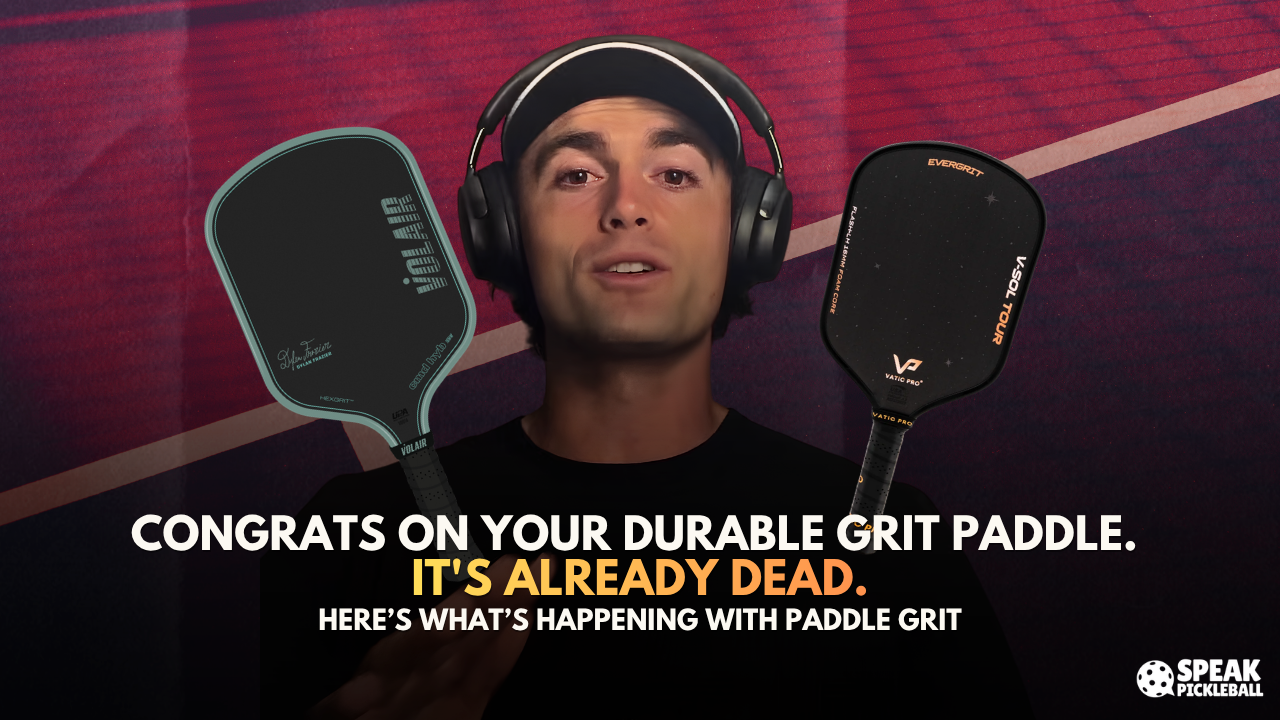
Congrats on your durable grit paddle. It's already dead. Here's why.
The durable grit race is getting messy.
Brands like 11SIX24 with HexGrit, Honolulu with Crystal Blue, Six Zero with Diamond Tough, and Spartus with P1 Permagrit have developed proprietary surfaces that appear to have solved one of pickleball’s biggest equipment problems: maintaining spin longer than traditional peel ply.
But the latest batch of releases shows how difficult that is to replicate. In some cases, new durable surfaces are producing worse spin than the peel-ply paddles they were supposed to replace.
Chris Olson of The Pickleball Studio reported poor out-of-box spin from the Enhance Armor Turbo and Pickleball Apes Zen S. Both paddles felt rough to the touch, but had noticeably glossy surfaces. Instead of grabbing the ball, the ball seemed to slide across the face.
The Vatic Pro V-Sol Tour had the opposite problem. It started with strong spin, then dropped quickly. Olson’s Flash went from roughly 2,380 RPM to 1,721 RPM after just one hour of drilling. Multiple used paddles showed similar losses.
John Kew also measured a decline in surface roughness on the V-Sol Tour, although his cannon-tested RPM remained relatively stable. Why those measurements tell different stories is still unresolved.

Vatic Pro acknowledged the issue, pointing to the difficulty of getting abrasive particles to behave consistently.
“Real-world spin loss obviously has a lot more factors. Sometimes the grit particles don't rise to the surface.”
The company says it was already developing another version before the recent testing:
“It’s going to be a more aggressive UPA version that also minimizes RT loss.”
That gets at the bigger issue. Durable grit is a materials-engineering problem, not simply a matter of making a paddle rougher.
Justin from Pickleball ETC argues that nearly every approach comes with trade-offs. Make a coating more wear-resistant and you can reduce friction. Add a second grit layer and it can chip or delaminate if the bond fails. Use too few abrasive particles and the resin between them can wear smooth, creating dead spots and inconsistent spin.
Even the best coatings still wear down. They just slow the process.
The difference, Justin argues, comes down to trade secrets: materials, machinery, abrasive density, and the exact application process.
James Ignatowich made a similar point on The Drop Podcast when discussing whether more brands would simply license HexGrit:
“I don't really think so because I think any of the brands that are willing to do some decent R&D and figure out how to get to tier one, they can do that... it's not prohibitively costly.”
He added:
“I was kind of surprised when we figured out tier one to say, ‘Okay, it's not rocket science.’”
Why Volair Licensed HexGrit
Volair took a different route. Instead of starting from scratch, it licensed HexGrit from 11SIX24, giving it access to a surface that already has months of real-world use behind it.
Volair CEO Ryan sees that as an opportunity to expand the market rather than cannibalize either brand:
“I envision it being a win win for 11SIX24, Volair and HexGrit. We have synergy needed to make this partnership possible. No I don't see it cannibalizing, but expanding our market and allowing more players to play with the best durable surface available.”
11SIX24 founder David Groechel argues that sharing the surface does not mean creating identical paddles.
“Players choose a paddle based on the complete package: its construction, shape, feel, power, control, and brand - not just the surface technology. Volair and 11SIX24 will continue to create distinct products for different players.”
For 11SIX24, licensing also turns HexGrit itself into a bigger business.
“By making HexGrit available more broadly, we believe we can grow awareness of the technology while strengthening both our own product line and our licensing business.”
Brands Are Responding Quickly but is it Enough?
To their credit, brands facing issues have moved fast.
Enhance Pickleball said it identified the problem affecting some early ArmorGrit reviewer samples and pushed back the public launch so those reviewers could receive new paddles and test them before release, saying, “We've identified the issue with some of the early reviewer samples and confirmed it won't affect the production units.”
Vatic Pro has also offered full refunds to customers concerned about their paddles while continuing development of its next grit formulation.
The bigger takeaway is not that these brands are cutting corners. It is that durable grit is much harder to engineer than it looks.
Brands have to balance friction, wear resistance, particle density, bonding, and manufacturing consistency, then reproduce that formula across thousands of paddles.
Some have figured it out. Others are still have some catching up to do.
Lorem ipsum dolor sit amet, consectetur adipiscing elit. Suspendisse varius enim in eros elementum tristique. Duis cursus, mi quis viverra ornare, eros dolor interdum nulla, ut commodo diam libero vitae erat. Aenean faucibus nibh et justo cursus id rutrum lorem imperdiet. Nunc ut sem vitae risus tristique posuere.
Lorem ipsum dolor sit amet, consectetur adipiscing elit. Suspendisse varius enim in eros elementum tristique. Duis cursus, mi quis viverra ornare, eros dolor interdum nulla, ut commodo diam libero vitae erat. Aenean faucibus nibh et justo cursus id rutrum lorem imperdiet. Nunc ut sem vitae risus tristique posuere.